

When sourcing insulated building materials for industrial, commercial, or cold storage projects, accurate cost forecasting is critical. In 2026, sandwich panel prices are driven by core material, thickness, steel gauge, coating type, and regional supply chains-variables that directly impact project budgets and supplier comparisons.
This guide breaks down 2026 global price ranges for PU, PIR, EPS, and rock wool sandwich panels, along with technical tradeoffs, application-specific selection logic, and hidden cost considerations to help buyers, engineers, and dealers make data-driven decisions.
2026 Global Sandwich Panel Price Ranges (By Core Material)
| Core Material | Price Range (FOB, $/m²) | Key Cost Drivers |
|---|---|---|
| EPS | $8 – $15/m² | Thin steel (0.3–0.4mm), basic PE coating; lowest upfront cost |
| PU | $12 – $25/m² | Balanced insulation/price; 0.4–0.5mm steel, standard coatings |
| PIR | $15 – $30/m² | Enhanced fire resistance; 0.45–0.6mm steel, PVDF coating options |
| Rock Wool | $18 – $35/m² | Non-combustible core; heavy-duty framing, fire-rated accessories |
Note: Prices reflect 50–100mm standard thickness; 100–200mm panels add 20–40% to base costs, while coastal/high-UV regions require PVDF coating (+10–15% premium).
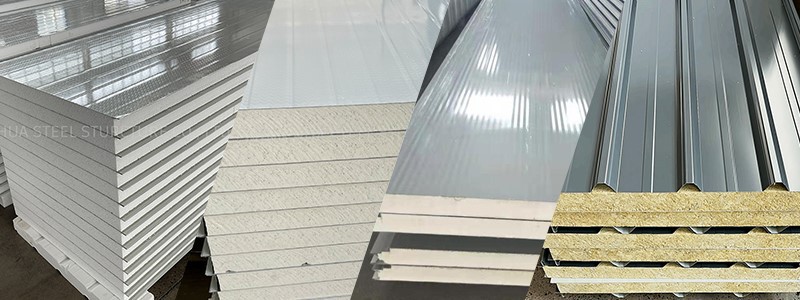
Core Material Performance & Cost Tradeoffs (Data-Backed)
| Panel Type | Insulation Performance (R-value) | Fire Resistance | Typical Lifespan | Best For |
|---|---|---|---|---|
| EPS | R-3 to R-5 per 50mm | Class E (limited fire resistance) | 15–20 years | Budget warehouses, poultry houses |
| PU | R-5 to R-7 per 50mm | Class B/C (self-extinguishing) | 20–25 years | General warehouses, cold rooms |
| PIR | R-6 to R-8 per 50mm | Class B (high fire resistance) | 25–30 years | Regulated commercial, cold storage |
| Rock Wool | R-3 to R-4 per 50mm | Class A (non-combustible) | 30+ years | Fire-rated buildings, high-safety zones |
EPS: The most cost-efficient option, ideal for low-budget projects where fire resistance is not a primary concern.
PU: Balances thermal performance and cost, making it the most widely used core for general industrial and commercial applications.
PIR: Delivers superior insulation and fire resistance, justifying the premium for regulated projects (e.g., food cold storage, pharmaceutical facilities).
Rock Wool: Non-combustible core meets strict fire codes, making it essential for high-safety environments (e.g., data centers, refineries).
Thickness & Steel Specification Cost Impact
1. Thickness Variation
Standard Warehouses: 50–100mm panels ($8–$25/m²) – balances cost and insulation for temperate climates.
Cold Storage: 100–200mm panels (+20–40% premium) – critical for maintaining -20°C to 4°C temperatures, reducing long-term energy costs by 30–50%.
Fire-Rated Buildings: 80–150mm rock wool panels – meets structural fire resistance requirements (1–2 hour fire rating).
2. Steel Gauge & Coating
Steel Thickness: 0.3mm (budget) → 0.6mm (heavy-duty) adds 10–25% to panel cost; thicker steel improves wind/snow load resistance.
Coating Type:
PE coating (standard): $0–$2/m² premium – suitable for inland, low-UV regions.
PVDF coating (high-durability): $2–$4/m² premium – mandatory for coastal/high-UV areas (prevents corrosion for 20+ years).
Application-Specific Selection Guide (2026)
| Application | Recommended Core Options | Selection Logic (Data-Backed) |
|---|---|---|
| Warehouse | PU / EPS / PIR | PU (60% market share) for general use; PIR for fire-regulated zones; EPS for budget projects. |
| Cold Room | PU / PIR | Both offer high insulation; PIR preferred for -20°C storage (better thermal stability). |
| Poultry House | EPS / PU | EPS for cost-sensitive operations; PU for cold climates (reduces heating costs by 25%). |
| Fire-Rated Building | Rock Wool / PIR | Rock Wool (Class A) for 2+ hour fire ratings; PIR (Class B) for 1-hour fire resistance. |
| Coastal/High-UV | All Cores (PVDF Coated) | PVDF coating required to resist salt spray/UV degradation; adds 10–15% to base cost. |
Hidden Costs to Consider (Total Cost of Ownership)
Beyond material prices, these factors impact total project cost:
Transport: $1–$5/m² (varies by distance; containerized shipments reduce costs for bulk orders).
Installation: $3–$8/m² (labor + accessories: sealants, fasteners, trim pieces).
Maintenance: $0.5–$2/m²/year (PVDF coating reduces maintenance costs by 50% vs. PE coating).
Energy Savings: Thicker insulated panels reduce HVAC costs by 20–50% over 20 years, offsetting upfront premiums.
FAQ Module
Q: What is the cheapest sandwich panel core in 2026?
A: EPS is the most cost-effective option, We can offer an EXW price as low as $6, ideal for budget projects where fire resistance is not a priority.
Q: Are PIR panels worth the higher cost vs. PU?
A: Yes for regulated projects-PIR offers 20% better insulation and higher fire resistance, justifying the 20–30% premium for cold storage or commercial buildings.
Q: How much does thickness affect sandwich panel pricing?
A: Each additional 50mm of thickness adds ~20% to the base price.
Q: Which coating is best for coastal regions?
A: PVDF coating is mandatory-it resists salt spray and UV radiation, extending panel lifespan by 10+ years vs. PE coating.


