

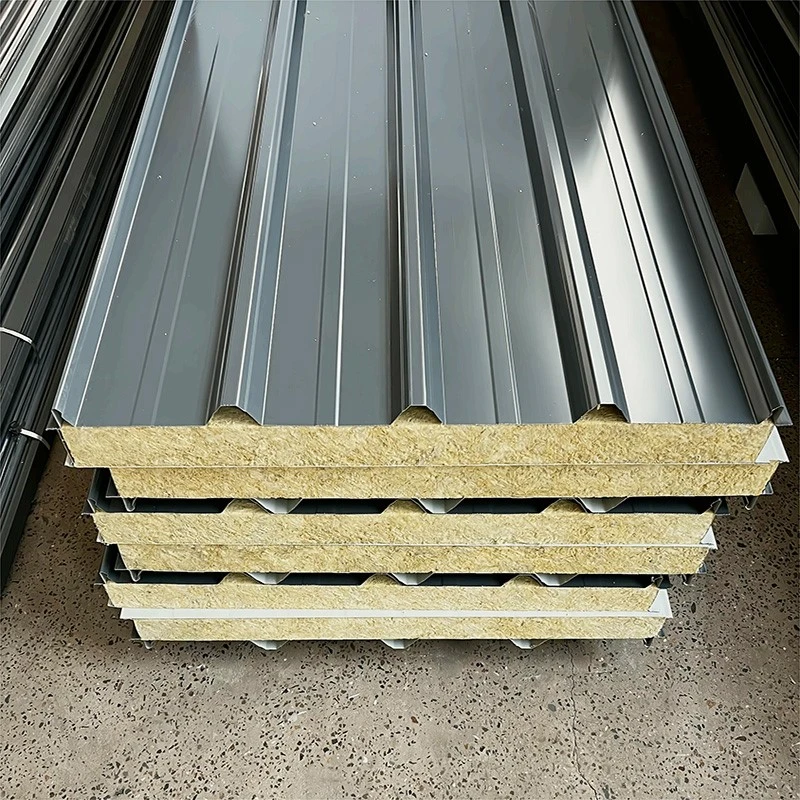
Rock wool sandwich panels are the most fire-resistant type of new fireproof panels in the sandwich panel series. They are made by melting natural rocks, blast furnace slag, etc. at high temperatures into fibers, and then solidifying and shaping them. They have a fire resistance of 600°C and a fire rating of A grade.
If fire safety is an unnegotiable requirement, then rock wool is the best choice.
The Pros: Where Rockwool Dominates Fire resistance is in a class of its own.
Rockwool is A2-s1,d0 rated per EN 13501-1 - essentially non-combustible. While PU and PIR cores can char or melt, Rockwool simply won't sustain a flame. This makes it the default choice for chemical plants, welding shops, battery storage rooms, and any project with strict fire codes.
Sound insulation is the best among sandwich panels. With a density of 80–120 kg/m³, Rockwool panels achieve RW=29–30 dB sound reduction and DELTA LA=15.7 dB(A) absorption. For noisy production floors or airports, that gap over PU (about 25 dB) is significant.
It's dimensionally stable and chemically inert. No plastic foam means no thermal expansion headaches, no degradation from solvents, and no smoke toxicity concerns in a fire.
The Cons: Where the Trade-Offs Bite It's heavy.
Rockwool panels weigh far more than foam-core panels, which means more structural steel, stronger foundations, and mechanical lifting equipment during installation. For a large warehouse roof, that added weight adds real cost to the frame.
Thermal insulation is weaker. Rockwool's conductivity is about 0.040–0.048 W/mK, compared to PU/PIR's 0.022–0.026. To achieve the same U-value, you need a thicker panel - which adds weight and cost.
It costs more and is fragile. Rockwool sandwich panels typically carry a higher price tag. The core is also brittle: rough handling or excessive foot traffic on the panel can cause delamination, where the mineral wool separates from the steel facings.
The Bottom Line
Choose Rockwool if your project involves high fire risk, strict code compliance, or noise-sensitive environments - and your budget can absorb the premium.
Choose PU or PIR if your priority is thermal efficiency per dollar, lightweight construction, or cost-sensitive general warehousing - and your fire code allows it.
Rockwool isn't the cheapest or the lightest. It's the one that won't burn.


