

A steel poultry house is often treated as a simple agricultural shed, but its interior is one of the most corrosive environments a structural frame will ever face. Farmers and buyers frequently assume that ordering "galvanized steel" solves the problem, and then discover three to five years later that bolt holes, column bases, welds, and panel edges are already rusting while the rest of the building still looks new. The reason is that ammonia, persistent humidity, condensation, high-pressure washing, and chlorine-based disinfectants attack the frame at the same time, and a thin commercial zinc layer or a basic paint film cannot survive that combination for long.

Why a Poultry House Is a Harsh Corrosive Environment for Steel
The Three Combined Attack Factors
Inside a working poultry house, steel does not face a single corrosive agent but three that reinforce each other.
The first is ammonia released from decomposing manure. Most ventilation guidelines recommend keeping ammonia below 25 ppm to protect bird health, but poorly managed litter or inadequate ventilation can push levels to 25–50 ppm or higher, and at those concentrations every metal surface under the roof is under continuous chemical attack.
The second factor is humidity. Relative humidity commonly stays above 70% for much of a flock cycle, and cold steel surfaces collect overnight condensation that dissolves ammonia and turns it into a weak alkaline electrolyte sitting directly on the coating.
The third factor is the empty-house routine: high-pressure washing between batches and chlorine-based disinfectants that leave residue on thin coatings and accelerate oxidation wherever the film is already worn.
These factors do not act separately. Ammonia in the air dissolves into the condensation film on a cold column or purlin, and that wet alkaline layer attacks both the organic paint film and the zinc layer beneath it. When the house is washed, residual disinfectant sits in bolt holes and panel laps, and if the surface is not rinsed and dried properly, corrosion continues even after the flock leaves. This is why a standard industrial coating that performs well in a dry warehouse can fail within a few years inside a chicken house.
Two Distinct Chemical Attack Mechanisms
It helps to separate the problem into two mechanisms that buyers often confuse. The first is ammonia attack, which targets the zinc layer and the paint film simultaneously. Ammonia combines with moisture to form ammonium hydroxide, a mild alkali that breaks down organic coatings from the surface and slowly consumes the metallic zinc. The second is disinfectant attack. Chlorine-based washing agents are standard between flocks, but when they are left to dry on a poorly specified surface, they accelerate rusting at every thin spot, scratch, or cut edge. Ordinary anti-rust paint mainly protects against rain and sunlight. It is not formulated for ammonia dissolved in condensation or for chlorine disinfectant residue, so it may soften and peel inside a poultry house. The specification should require a chemically resistant coating system rather than generic "anti-rust paint."
Broiler, Layer, and Breeder Houses Carry Different Corrosion Loads
The corrosion load also changes with the production type, which is why one universal spec rarely fits every project. A broiler house runs in short batches and goes through repeated empty-house washing cycles, so humidity swings sharply between wet cleaning and dry rearing, and the frame sees frequent mechanical impact from pressure washing. A layer house operates almost continuously, with cages, manure belts, and fixed equipment running year-round, so ammonia is present steadily for the longest period and the corrosion exposure accumulates over many years without a long dry break. A breeder house carries more equipment, more hanging points, and more nodes where water and manure can collect, which means more weak points to protect. A specification written for a simple broiler shed should not be copied unchanged onto a high-density layer house, because the layer environment demands a heavier zinc layer, a better topcoat, and more attention to internal nodes.
Classify the Environment Before Choosing Protection
ISO 12944 Atmospheric Corrosivity Categories
Before selecting a galvanizing or paint system, the environment should be classified under ISO 12944, which divides atmospheric corrosion into C1 (very low), C2 (low), C3 (medium), C4 (high), C5-I (very high industrial), and C5-M (very high marine). A clean heated office sits in C1, a rural unheated warehouse sits around C2, and an urban or light industrial building sits in C3. A poultry house interior, however, should not be classified by the fact that it is indoors. Because it combines ammonia, high humidity, and condensation, it normally falls into C4, and in coastal, tropical, or poorly ventilated regions it should be treated as C5-I. Writing the wrong category into the specification is the most common reason a cheap coating system fails early.
Why "Indoor" Does Not Mean Mild
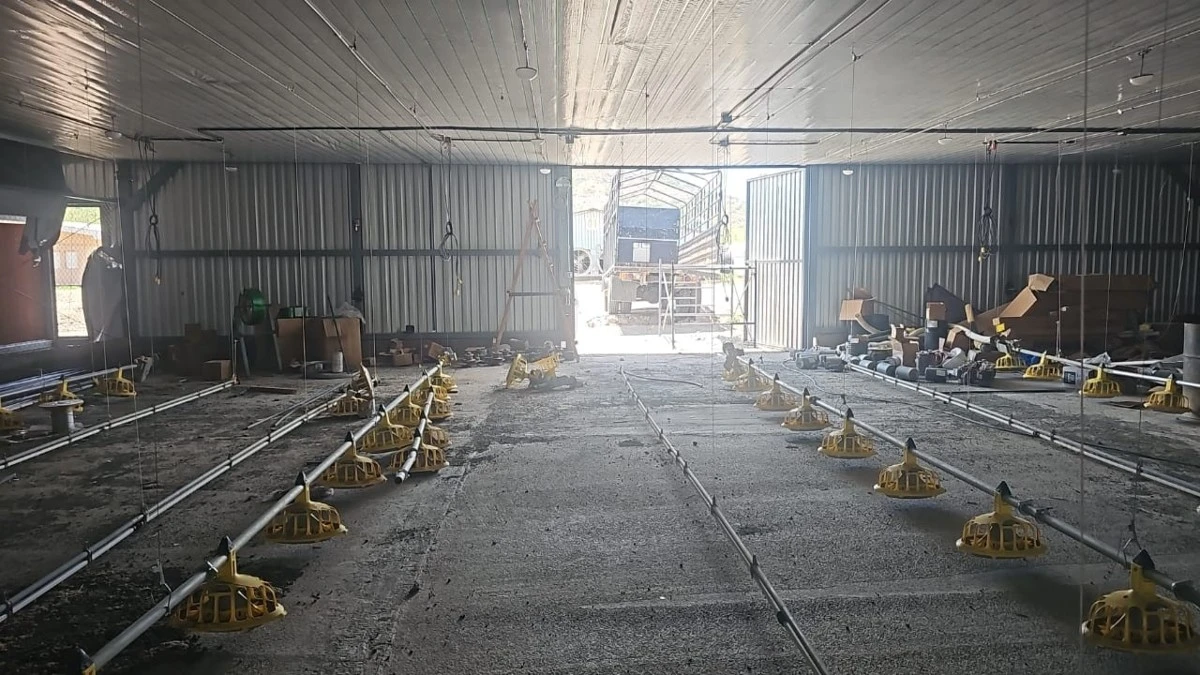
Many buyers classify a chicken house as an ordinary indoor building and select a C2 or C3 paint system, but an enclosed poultry house is not a dry interior. The air inside carries ammonia, the walls and roof collect condensation, and washing water remains in joints after cleaning. That combination produces a corrosive stress level closer to a humid industrial process room than to a storage space. The practical consequence is that the coating thickness, zinc weight, and topcoat chemistry should be chosen for C4 or higher, even though the building has no exterior weather exposure in the conventional sense.
Local Climate Adjustment
The same drawing can perform very differently in different countries. A tropical high-humidity region adds constant moisture and faster condensation, a coastal site adds salt mist on top of ammonia, and a cold northern house reduces ventilation in winter to save heat, which traps ammonia and moisture inside. Each of these conditions raises the corrosivity category, so the specification should state the local climate assumption rather than quoting a generic coating table. A C4 system that lasts well in a temperate inland farm may need to be upgraded to C5-I on a coast or in a humid lowland region.
Primary Structure: Batch Hot-Dip Galvanizing
Batch HDG vs. Coil Galvanizing
The main frame, including columns, rafters, trusses, fabricated H-sections, and hollow sections, should receive batch hot-dip galvanizing, covered by ASTM A123 in the United States or ISO 1461 internationally. These standards apply to fabricated steel pieces dipped in molten zinc after fabrication, and they set minimum average and local coating thickness by steel thickness. Roof sheets, wall panels, and light cold-formed purlins, by contrast, use continuously coil-galvanized products covered by ASTM A653 (such as G90) or ASTM A792 (such as AZ55). These are two different processes with two different thickness scales, and mixing them up in a purchase order is a procurement mistake: a coil-sheet spec such as G90 does not provide the coating mass that a fabricated column requires.
Under ISO 1461, steel thicker than 6 mm requires a mean coating of at least 85 µm and a local minimum of 70 µm. Steel from 3 to 6 mm requires a mean of 70 µm and a local minimum of 55 µm, while steel from 1.5 to 3 mm requires a mean of 55 µm and a local minimum of 45 µm. ASTM A123 sets slightly higher minimums for most thicknesses and product categories, so the contract should name the standard used in the destination market rather than leaving "galvanized" undefined.
Why Galvanizing Beats Paint Alone on the Frame
Hot-dip galvanizing works because the zinc layer forms a metallurgical bond with the steel and provides sacrificial protection: if the surface is scratched, the surrounding zinc corrodes first and protects the exposed steel underneath. A paint film only forms a physical barrier, and once that film is broken, corrosion starts at the wound and spreads underneath the coating. For a main frame that must last fifteen to twenty years, batch galvanizing is therefore the preferred baseline, because it keeps protecting the structure even where handling, drilling, or field assembly damages the surface.
Paint Alternative When HDG Is Not Possible
Large or special components that cannot be hot-dip galvanized should use a full paint system designed for C4 or C5 rather than a single shop primer. A typical alternative combines an epoxy zinc-rich primer, an epoxy build coat, and a polyurethane or fluoropolymer topcoat, with total dry film thickness above 250 µm for high-corrosion service. The steel surface must be prepared to Sa2.5 before coating, and each layer's dry film thickness should be written into the order. This system can protect the frame, but it lacks the sacrificial self-healing of galvanizing, so any field scratch must be repaired promptly.
Electro-Galvanized vs. Hot-Dip Galvanized
Electro-galvanizing produces only 10–15 µm of zinc and commonly fails within three to seven years in a poultry house, while hot-dip galvanizing reaches 60–85 µm and can serve fifteen to twenty-five years. This distinction matters especially for small parts and fasteners, where suppliers sometimes substitute electro-galvanized bolts for hot-dip ones to reduce cost. The specification should name the galvanizing process, not just the word "zinc plated," because the two products are not interchangeable in an ammonia environment.
Cladding and Purlins: PPGI Spec for Ammonia
Zinc Coating Weight for Roof and Wall Sheets
For cold-formed purlins, girts, and wall supports, Z275 coil coating (275 g/m² of zinc, roughly 20 µm per side) is the practical baseline for a poultry house. In coastal or high-humidity projects, the zinc weight should be raised, or an aluminum-zinc alloy coating such as AZ55 or a zinc-aluminum-magnesium coating should be considered, because these alloys resist ammonia and moisture better than plain zinc at the same thickness. The cladding sheet itself should also carry a heavier metallic coating than a standard industrial roof, since the interior face of the panel sits directly in the ammonia-laden air.
Topcoat: PE, SMP, HDP, and PVDF
The topcoat chemistry determines how well the panel resists ammonia, cleaning agents, and UV exposure. Polyester (PE) is the low-cost baseline and offers only basic protection, suitable for low-exposure sheds rather than intensive poultry houses. Silicone-modified polyester (SMP) improves weather resistance and works for general agricultural roofing, but it is still not the strongest choice for continuous ammonia. High-durability polyester (HDP) offers better chemical resistance and is the practical mainstream choice for poultry and livestock buildings. PVDF fluoropolymer provides the longest color retention and the best chemical resistance, and it is selected for premium or long-life houses where the extra cost is justified by a twenty-year service target. A basic PE topcoat should be avoided inside a chicken house, because it blisters and chalks under ammonia and repeated washing.
Film Thickness and Backer Coat
The front topcoat should reach 20–25 µm or more, with a 5–8 µm primer beneath it, and the reverse side facing the interior should not receive only a 5 µm wash coat. In a condensing environment, the backer coat should be at least 7–10 µm of corrosion-inhibiting epoxy or polyester, because the inner face collects moisture and ammonia just as much as the exterior face collects rain. The buyer should ask the supplier in writing for total paint film thickness and for written confirmation of ammonia resistance, rather than judging the panel by color alone.
Cut Edges, Seams, and Fixings
The cladding fails first at its details rather than on its flat face. Cut edges, nail holes, overlapping seams, and flashing joints trap moisture and ammonia, and an unprotected cut edge starts rusting long before the painted center of the panel fails. These areas should be sealed during installation, and the fixing screws should be stainless steel or hot-dip galvanized rather than ordinary electro-galvanized self-drilling screws, which corrode and break within a few years under pressure washing.
Weak Points That Fail First
Column Base
The column base is the most vulnerable point in the whole frame. It sits near manure, floor wash water, and ground moisture, and the zinc layer there is often damaged during erection. The base should be raised and encased in concrete for at least 300 mm above floor level so that manure and standing water do not touch the steel directly. Anchor bolts should be coated with rust-preventive grease and wrapped in waterproof material, because root-level bolts attract moisture and rust from below.
Bolts and Fasteners
Standard electro-galvanized bolts commonly fail within three to five years inside a poultry house, while 304 stainless steel or hot-dip galvanized Grade 8.8 fasteners remain reliable. The unit price difference per bolt is small, but replacing a corroded high-strength bolt in an assembled frame means downtime, disassembly, and safety risk, so the fastener grade should be listed separately in the purchase order rather than left to the supplier's default.
Welds and Field Cuts
Field welding destroys the galvanized layer locally, and if the weld is not repaired, the heat-affected zone becomes a rust starter. After welding, the area must be ground clean and repaired with zinc-rich paint or thermal zinc spray matching the surrounding coating. The order should also state whether holes are drilled after galvanizing or before it, because a hole cut after galvanizing loses its zinc on the cut edge and needs local touch-up, while a hole drilled before galvanizing receives full coating on its inside edge.
Purlins, Panel Back, and Cold Spots
The back face of a purlin and the inner side of the roof panel are condensation dead zones that few people inspect. These areas collect overnight moisture and ammonia, so they need the higher zinc coating weight described earlier. Cold bridges where insulation is missing also produce internal condensation, and strengthening insulation at those points reduces the wetting that consumes the zinc layer.
Design Choices That Reduce Corrosion
Ventilation and Litter Management
The cheapest corrosion control is not a thicker coating but a controlled environment. Ventilation that keeps ammonia below 25 ppm lowers the chemical attack on every coated surface, and dry litter reduces the amount of ammonia released in the first place. A house that runs with poor ventilation forces the zinc and paint system to work much harder, and no coating can fully compensate for chronic ammonia buildup.
Insulation and Vapor Barrier
Insulation together with a proper vapor barrier reduces surface condensation on inner walls and roof panels. Less condensation means less ammonia dissolved into water on the steel, which directly extends the life of both galvanizing and paint. A well-insulated house therefore protects the structure as much as it protects bird comfort.
Drainage and Housekeeping
The floor should slope so that wash water runs away from column bases instead of pooling around them. Manure should be removed on schedule to cut ammonia release, and after washing the house should be ventilated until metal surfaces are dry. Leaving moisture on the frame after cleaning is a routine cause of early rust, even when the material specification was correct.
Writing the Corrosion Spec in the Purchase Order
The purchase order should separate the protection requirements by component so that each part can be checked independently. For the main structure, the order should name ASTM A123 or ISO 1461 and state the minimum mean and local coating thickness for the steel thickness used. For the cladding, it should list the zinc coating weight, the topcoat system such as HDP or PVDF, and the front and back film thicknesses. Fasteners should be listed with their material grade rather than described generically as bolts. Joint requirements, including weld touch-up, column base concrete encasement, and cut-edge sealing, should be written explicitly, and the supplier should be asked to provide coating thickness measurement reports and a written coating warranty rather than a verbal assurance that the steel is "galvanized."
Inspection and Maintenance
Even a well-specified frame needs periodic inspection during each empty-house window. Column bases, anchor bolts, welds, panel edges, and screw holes should be checked for rust or coating damage, and any scratch in the galvanized layer should be repaired with zinc-rich paint before rust spreads. After washing, standing water in joints should be noticed and ventilated dry, and the coating condition should be recorded so that future repairs can be planned. Corrosion in a poultry house progresses quietly, and early touch-up costs far less than replacing a purlin or a joint after the section has rusted through.
Cost vs. Service Life
A low-specification combination of electro-galvanized parts and basic PE coating looks cheap at signing, but it commonly requires purlin and node replacement within three to seven years. Batch hot-dip galvanizing combined with HDP cladding costs more up front but delivers fifteen to twenty years of low-maintenance service. When the building is evaluated over a twenty-year cycle, the thicker coating system usually costs less because it avoids replacement labor, downtime, and safety risk. The buyer should compare total life-cycle cost rather than only the first price on the quotation.
Frequently Asked Questions
How long does a galvanized frame last in a poultry house?
With proper batch hot-dip galvanizing, a C4-class specification, and routine maintenance, a frame can last fifteen to twenty years or more. Light commercial galvanizing without these conditions may need purlin or joint replacement within seven years.
Should layer and broiler houses use the same corrosion spec?
Not ideally. A layer house runs continuously with steady ammonia exposure and should use the heavier zinc and topcoat system, while a broiler house with batch washing cycles can be specified according to its local climate and cleaning frequency.
Is HDP worth the extra cost over PE?
For an ammonia environment, HDP is normally worth the investment because PE chalks and blisters under repeated washing and ammonia exposure, while HDP maintains its film for a much longer period. PVDF should be considered only for premium or very long-life buildings.
Why does the column base rust first?
The base collects manure, wash water, and ground moisture, and it often receives mechanical damage during erection, so concrete encasement and bolt protection are essential.
Can a paint-only system replace galvanizing?
A high-build epoxy and polyurethane system can protect a frame, but it lacks sacrificial self-healing, so every field scratch must be repaired immediately. Galvanizing remains the more reliable baseline for the main frame.
Conclusion
Ammonia corrosion in a poultry house is not solved by adding one coat of anti-rust paint. It requires a combined approach: classifying the interior as C4 or higher, specifying batch hot-dip galvanizing for the main frame under ASTM A123 or ISO 1461, selecting HDP or PVDF cladding with adequate zinc weight and backer coat, upgrading fasteners and column bases, and supporting all of this with ventilation, dry litter, insulation, and drainage. When these elements are written clearly into the purchase order and checked during production, the steel frame can reach its intended fifteen-to-twenty-year service life rather than failing after a few seasons of ammonia and washing.


